Affiliate Programs: A Comprehensive Guide for Beginners
If affiliate marketing is the business, then affiliate programs are the marketplace. Understanding these programs is the secret to moving from a hobbyist to a professional affiliate partner.
What is an Affiliate Program?
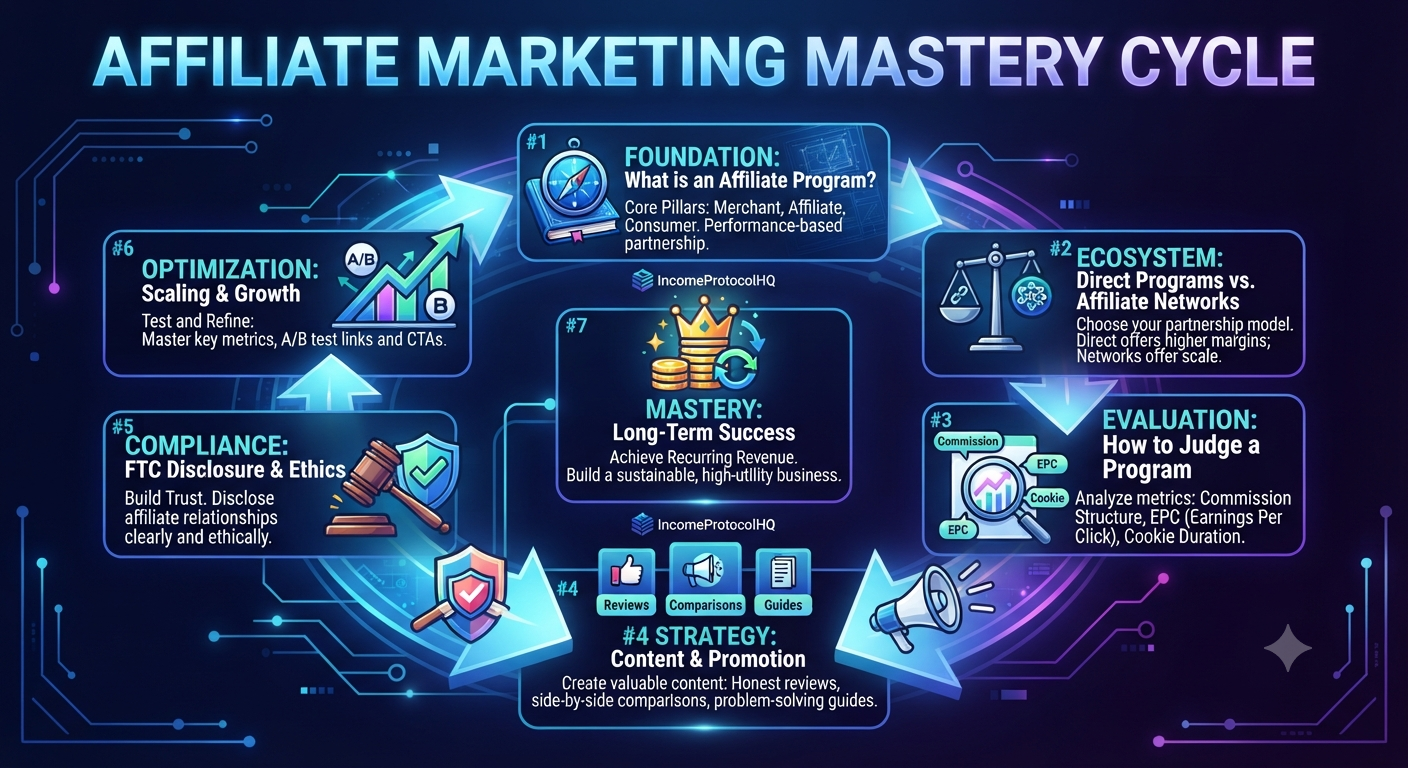
An affiliate program is a direct, performance-based arrangement between a merchant—a business selling a product or service—and an affiliate—the marketer promoting it. Think of it as a structured partnership. The merchant provides the product, handles the inventory, manages shipping, and provides customer support. You, the affiliate, provide the marketing reach. When a customer completes a specific action (like a sale or sign-up) through your unique tracking link, you are rewarded with a commission.
The Three Pillars of Affiliate Programs
To navigate these programs effectively, you need to understand three core components:
The Merchant (The Seller): The business that creates the product or service. They define the rules, such as commission rates and cookie durations.
The Affiliate (The Promoter): You. Your job is to connect the merchant’s solution to an audience that actually needs it.
The Affiliate Network (The Intermediary): Often, a merchant won't manage their own program. Instead, they use an affiliate network—a platform that acts as a central hub where merchants list their programs and affiliates can browse to find products to promote.
Direct Programs vs. Affiliate Networks
As you grow, you will choose between two ways to find products:
1. Affiliate Networks
Platforms like CJ Affiliate or ShareASale act as a middleman.
Pros: Immediate access to hundreds of brands; unified tracking and payments.
Cons: Usually involve platform fees; less direct relationship with the brand.
Best for: Beginners who are still testing the waters.
2. Direct Affiliate Programs
These are programs managed directly by the company (e.g., a software company hosting their own program on their website).
Pros: Often offer higher commission rates; opportunity to build a closer relationship with the brand.
Cons: Requires managing individual accounts for every brand you promote.
Best for: Experienced affiliates who have identified their niche and want to maximize profit.
How to Evaluate a Program
Not all programs are created equal. Before you sign up, check these four metrics:
Commission Structure: Is it a flat fee (e.g., $50 per sale) or a percentage?
Cookie Duration: This is the "shelf-life" of your referral. If a program has a 30-day cookie, you get credit for a sale even if the customer waits a few weeks to buy after clicking your link.
Payment Threshold: Some programs require you to earn $100 before paying out; others have no minimum.
Brand Reputation: Only promote products you would personally use. Your reputation depends on the quality of the brands you recommend.
Frequently Asked Questions About Affiliate Programs
Still have questions about how affiliate programs work? Here are the answers to the most common hurdles beginners face when starting their journey.
Do I need a website to join an affiliate program? While having a professional website helps, it is not strictly required. Many programs accept creators who have an active, engaged audience on platforms like YouTube, Instagram, or TikTok. However, owning your own domain allows you to build a more sustainable business and collect leads via email.
Is there a cost to join these programs? Reputable affiliate programs are free to join. If a program requires you to pay a fee just to sign up or "unlock" access to affiliate links, it is likely not a legitimate partnership opportunity.
How long does the approval process take? Approval timelines vary significantly. Some programs offer instant approval, while others may take anywhere from 3 to 7 business days as the merchant reviews your traffic sources and content strategy to ensure a good brand fit.
Can I promote my links via paid advertising? This depends entirely on the merchant's terms and conditions. Some brands encourage it, while others strictly prohibit paid ads (like Google or Facebook Ads) for their affiliate links to avoid competing with their own marketing efforts. Always check the program's "Terms of Service" before spending money on ads.
How do I actually get paid? Most programs pay via direct deposit, PayPal, or wire transfer. Be sure to check the "Payout Method" and the "Payment Threshold"—the minimum amount you must earn before the company releases your payment—before joining.
Anatomy of a "High-Quality" Program
Not all affiliate programs are created equal. As a professional, you should treat your time as an asset and only partner with programs that provide the infrastructure you need to succeed. Use this checklist to identify a "High-Quality" program:
Comprehensive Resource Library: A top-tier program provides more than just a link. Look for merchants that offer "affiliate kits," including high-quality banners, email swipe copy, pre-made social media assets, and product demo videos.
Dedicated Support & Communication: The best partnerships are two-way streets. A high-quality program should offer a responsive affiliate manager or a clear, direct contact channel to resolve technical issues or discuss promotional strategies.
Transparent Terms: Professional programs prioritize clarity. They should explicitly state their commission rates, payment schedules, and cookie windows upfront, so you always know exactly how and when you will be compensated.
High-Utility Product/Service: Always prioritize the quality of the offer for your audience. A great program is built around a product or service that solves a genuine "micro-problem," ensuring that your recommendations truly add value rather than just chasing a commission.
Key Metrics for Program Success
Treating your affiliate business like a trading strategy requires analyzing performance data to identify what is actually working. Use these key metrics to gauge the profitability and efficiency of the affiliate programs you join:
EPC (Earnings Per Click): This metric calculates the average amount you earn for every 100 clicks your affiliate link receives. It is a powerful benchmark for comparing the potential profitability of different programs against one another.
Conversion Rate: This represents the percentage of users who click your link and then complete a purchase or sign-up. A high conversion rate suggests that the merchant's landing page is effective at turning your traffic into revenue.
Cookie Duration: This defines how long your tracking link remains active after a user clicks it. A longer duration (typically 30 days or more) is highly favorable, as it increases the window of time in which you can earn a commission from a single lead.
Attribution Model: It is vital to understand whether a program uses "first-click" or "last-click" attribution. This determines which affiliate gets credit if a user interacts with multiple pieces of content before finally making a purchase.
When reaching out to brands, you must treat the email like a professional "business proposal" rather than a sales pitch. Your goal is to show the merchant that you understand their product and have an audience that fits their target market.
Here are three templates tailored for your brand, designed to build authority and secure partnerships.
Template 1: The "Utility-First" Pitch
Use this when you already use the tool and want to showcase its value to your audience.
Subject: Partnership Inquiry: Featuring [Product Name] for my [Your Niche/Audience]
Hi [Name of Affiliate Manager or Marketing Lead],
I’ve been using [Product Name] for my own operations and have been impressed by how it solves [Specific Micro-Problem].
I run a niche resource site, [yourdomain.com], where I help [Target Audience, e.g., aspiring solopreneurs] build their businesses using high-utility tech. I am currently planning a series of deep-dive guides on [Topic, e.g., funnel automation], and I believe your tool would be a perfect fit for my readers.
Do you have an active affiliate program I could join to promote [Product Name] to my community? I am committed to producing high-quality, transparent content that converts.
Looking forward to your thoughts,
[Your Name] yourdomain.com
Template 2: The "Strategic Alignment" Pitch
Use this when you are reaching out to a brand that aligns with your "Core Tech Stack" and you want to demonstrate your potential impact.
Subject: Affiliate Partnership Opportunity with IncomeProtocolHQ
Hi [Name],
I am currently building out a "Core Tech Stack" for my readers at [yourdomain.com], specifically focusing on [Industry, e.g., SEO and Marketing Intelligence].
I have been following [Product Name] for some time and see a significant overlap between your solution and the challenges my audience is trying to solve. I’d love to include you in my upcoming [Guide/Comparison Table/Video] as a recommended tool.
Could you let me know if you manage your affiliate program directly or via a network, and if you have any resources (banners, swipe copy, or demo access) available for new partners?
Best regards,
[Your Name] yourdomain.com
Template 3: The "Data-Driven" Pitch (For established traffic)
Use this if you have existing content and want to show them why you are a valuable partner.
Subject: Affiliate Partnership Inquiry: IncomeProtocolHQ ([Monthly Traffic/Subscribers])
Hi [Name],
My name is [Your Name], and I run [yourdomain.com]. My audience consists of [Describe your audience, e.g., beginner day traders and solopreneurs] who are actively looking for tools to optimize their [specific process].
I’ve been looking for a long-term partner in the [Product Category] space, and [Product Name] is at the top of my list based on its [specific feature/utility].
Last month, my site generated [Number] visitors interested in [Niche Topic]. I’d love to discuss how we can position your product in front of them to drive consistent, high-intent traffic.
Are you open to discussing an affiliate partnership?
Best,
[Your Name] yourdomain.com
💡 Pro-Tips for Outreach:
Keep it brief: Affiliate managers are busy. They care about two things: Is your traffic relevant, and do you have a plan to promote them?
The "FTC" touch: If you want to stand out, mention in your follow-up that you are fully committed to ethical, FTC-compliant promotion. It shows you are a professional, not a spammer.
Personalize: Always try to find the name of the Affiliate Manager or Marketing Lead on LinkedIn rather than sending to a generic "support@" email.
1. Classification by Payout Trigger (Action-Based)
These programs define exactly what action the customer must take for you to earn a commission.
Pay-Per-Sale (PPS/CPS): The most common model [1.2.3, 1.2.5]. You earn a commission only when a referred customer completes a purchase [1.2.1, 1.2.5]. This is low-risk for merchants and highly popular in e-commerce [1.2.1, 1.2.3].
Pay-Per-Lead (PPL/CPL): You earn a commission when a user completes a specific "lead" action, such as filling out a contact form, signing up for a free trial, or requesting a demo [1.2.1, 1.2.5]. It is very common in B2B, SaaS, and financial services [1.1.2, 1.2.3].
Pay-Per-Click (PPC/CPC): You earn a small fee simply for sending traffic to the merchant’s site, regardless of whether they buy anything [1.2.1, 1.2.3]. While this is great for building traffic, it is less common for high-value partnerships and requires strict fraud prevention [1.2.1, 1.2.3].
Pay-Per-Install (CPI): Common for mobile apps or downloadable software. You earn a commission whenever a user installs the app via your link [1.2.2, 1.2.3].
2. Classification by Commission Structure (Payment Model)
These models determine how much you are paid and over what timeframe.
Flat-Rate Commission: You receive a fixed dollar amount per conversion (e.g., $50 per sale), regardless of the order size [1.2.1, 1.2.4].
Percentage Commission: You receive a percentage of the total transaction value (e.g., 10% of a $500 order) [1.2.1, 1.2.4]. This scales well with higher-ticket sales [1.2.4].
Recurring Commission: You earn a commission not just on the first sale, but every time the customer renews their subscription [1.2.1, 1.2.4]. This is the "gold standard" for SaaS and membership programs [1.2.4].
Tiered Commission: Your commission rate increases as you hit higher performance milestones (e.g., 10% for your first 10 sales, 15% after that) [1.2.1, 1.2.5]. This is highly motivating for top-tier affiliates [1.2.1, 1.2.5].
Lifetime Commission: You receive a commission on every future purchase that customer makes with the brand, potentially for the entire duration of their relationship with the company [1.2.5].
3. Strategic Considerations for Your Guide
When adding this to your site, you can frame these types through the lens of your "Core Tech Stack" philosophy:
For Beginners: Emphasize PPS (Pay-Per-Sale) programs as they are the most straightforward to track and often the most abundant [1.2.3].
For High-Utility Content: Recommend Recurring Commission models [1.2.4]. Since you focus on tools like funnels and automation, recurring revenue allows you to build a stable, predictable income stream from a single customer referral.
For Lead Generation: If your content solves "micro-problems" (like setting up a specific software), PPL (Pay-Per-Lead) programs for SaaS trials are excellent ways to monetize even before a full sale happens [1.2.3].
Subscribe to our newsletter
Enjoy exclusive special deals available only to our subscribers.